
Table of Contents
F-1-5 Child-Rearing Visiting and Family visitor (F-1-5)
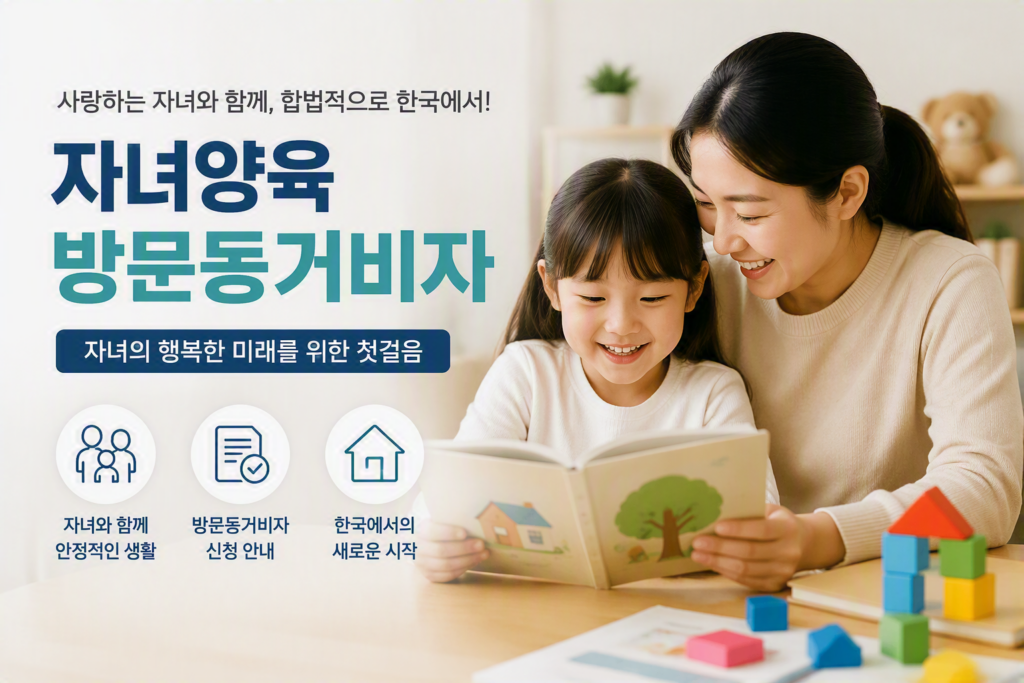
Many foreign nationals residing in Korea wish to enter or remain in the country to care for their children living in Korea. In such cases, one of the most commonly used residence statuses is the F-1-5 Child-Rearing Visiting and Cohabitation Visa. This visa is particularly popular among international marriage families, naturalized Korean citizens, and permanent resident families.
In this article, we will take a detailed look at the eligibility requirements, necessary documents, period of stay, extension procedures, and important considerations for the F-1-5 Child-Rearing Visiting and Cohabitation Visa.
What is the F-1-5 Child-Rearing Visiting and Cohabitation Visa?
The F-1-5 visa is a Visiting and Cohabitation (F-1) residence status granted to foreign parents who need to raise or care for their minor children residing in the Republic of Korea.
The visa is designed to support family unity and child welfare under Korea’s immigration framework. It allows foreign parents to reside in Korea for the purpose of caring for children who are either Korean nationals or legally residing in Korea.
In other words, the visa permits foreign parents to enter and stay in Korea to provide childcare, protection, and daily support for their children.
Who Can Apply for an F-1-5 Visa?
The following individuals may be eligible to apply for an F-1-5 Child-Rearing Visiting and Cohabitation Visa.
1. Parents Raising a Minor Child with Korean Nationality
This is the most common category.
Applicants must generally satisfy the following requirements:
- The child holds Korean nationality.
- The child is a minor.
- The parent is actively involved in raising or caring for the child.
Even after divorce or the death of a spouse in an international marriage, a parent who continues to raise the child may be eligible for this visa.
2. Parents of a Naturalized Korean Citizen
Parents whose child has acquired Korean nationality through naturalization may qualify if they are required to stay in Korea to provide support, care, or family assistance.
However, the purpose of stay must go beyond simple visitation and demonstrate a genuine need for family cohabitation and support.
3. Cases Requiring Protection of a Child Residing in Korea
Applications may also be considered where a child legally residing in Korea requires parental care or protection.
Examples include:
- Single-parent households
- Parental divorce
- Death of a spouse
- Ongoing need for child care and supervision
Key Requirements for the F-1-5 Visa
Immigration authorities comprehensively review the following factors.
Proof of Parent-Child Relationship
The relationship between the parent and child must be objectively verified.
Required documents may include:
- Birth certificate
- Family relationship certificate
- Other documents proving kinship
Documents issued overseas may require an Apostille certification or consular legalization.
Actual Child-Rearing Responsibilities
Simply being a biological parent may not be sufficient.
Immigration authorities may evaluate:
- Financial support provided for the child
- Whether the parent and child live together
- The necessity of parental care
- The age of the child
In general, childcare needs are more readily recognized for preschool and elementary school-aged children.
Financial Capability
Applicants must demonstrate sufficient financial resources to support themselves and their children.
Examples of supporting documents include:
- Bank balance certificate
- Income tax certificate
- Employment certificate
- Business registration certificate
Period of Stay under the F-1-5 Visa
Individuals granted an F-1-5 visa are generally permitted to stay for one of the following periods:
- Three years (for parents with multiple children; renewal frequency may not be limited, although overall stay conditions may apply)
- Four years (the maximum period typically granted upon an initial application where long-term residence is justified)
The actual period granted depends on individual circumstances and may vary from case to case.
Applicants may apply for an extension before the expiration of their authorized stay.
As long as the child remains a minor and the need for parental care continues, extensions are often possible.
Required Documents for an F-1-5 Visa Application
The following documents are commonly required.
Basic Documents
- Passport
- Alien Registration Card (if already residing in Korea)
- Integrated Application Form
- Passport-sized photograph
Family Relationship Documents
- Birth certificate
- Family relationship certificate
- Basic certificate
- Resident registration record
Financial Documents
- Proof of income
- Employment certificate
- Tax payment certificate
- Bank balance certificate
Additional Documents
- Evidence of child-rearing activities
- School enrollment certificate
- Medical records, if applicable
Additional supporting documents may be requested depending on the specific circumstances of the case.
Is Employment Allowed on an F-1-5 Visa?
This is one of the most frequently asked questions.
The F-1-5 Child-Rearing Visiting and Family Visitor Visa is not a status that automatically grants unrestricted employment rights.
In some situations, separate authorization or a change to another residence status may be required before engaging in employment.
Therefore, individuals planning to work in Korea should carefully review the requirements applicable to their specific immigration status.
Important Considerations When Extending an F-1-5 Visa
During extension reviews, immigration authorities typically examine:
- Whether the applicant continues to live with the child
- Whether the applicant remains actively involved in child-rearing
- Compliance with Korean laws and regulations
- Continued financial stability
If there is prolonged separation from the child or insufficient evidence of actual child-rearing, an extension may be denied.
Frequently Asked Questions (FAQ)
Who is the F-1-5 Visa Intended For?
The visa is intended for foreign parents who wish to raise or care for their children residing in Korea.
Must the Child Hold Korean Nationality?
The primary category involves parents of minor children who are Korean nationals. However, eligibility may vary depending on individual circumstances.
How Long Can I Stay on an F-1-5 Visa?
The permitted period may vary. Extensions are generally available when the child-rearing relationship continues. The maximum extension period may differ depending on the number of children and individual circumstances.
Can I Work with an F-1-5 Visa?
In principle, employment is not permitted unless separately authorized under applicable immigration regulations.
Conclusion
The F-1-5 Child-Rearing Visiting and Cohabitation Visa is an important residence status that enables foreign parents to provide stable care and support for their children in Korea. For parents of Korean-national minor children, it serves as a valuable mechanism for family reunification and child welfare.
Because immigration authorities carefully assess factors such as the parent-child relationship, the necessity of child-rearing, financial capability, and cohabitation arrangements, thorough preparation is essential before applying.
Seeking professional immigration assistance can often make the application, extension, or status-change process more efficient and successful.